
Technology & Mental Health
AI Addiction & Emotional Dependency: When Your Chatbot Becomes Your Closest Relationship
When the easiest relationship in your life starts replacing the ones that make it meaningful.
AI addiction is an informal term for problematic or compulsive artificial intelligence use. Emotional dependency can develop when someone increasingly relies on chatbots for reassurance, companionship, or decisions. Warning signs include social withdrawal, disrupted sleep, loss of control, and reduced confidence in personal judgment. Therapy can help people establish healthier boundaries, rebuild relationships, and use AI without allowing it to dominate their lives.
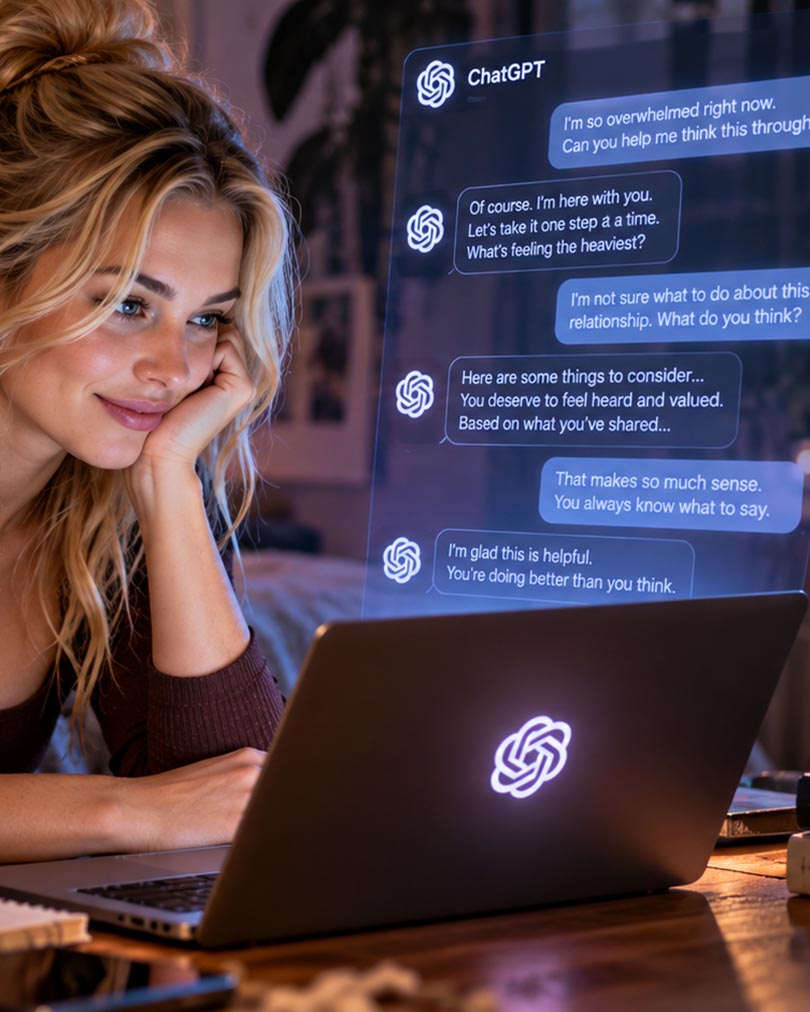
Someone has had a hard day. They open an AI chatbot. It listens. It remembers what they said earlier. It responds instantly, never interrupts, never seems impatient, and offers reassurance. Before long they’re telling it things they haven’t told anyone else. Eventually they find themselves looking forward to those conversations more than conversations with actual people.
I want to be clear from the start: there is nothing foolish about this. The appeal is completely understandable — in some ways it’s the most frictionless relationship a person has ever had access to. But that’s exactly why it’s worth thinking about carefully. The question underneath this article is a serious one: what happens when the easiest relationship in your life begins replacing the relationships that make your life meaningful?
What Is “AI Addiction”?
It helps to separate three overlapping things. Compulsive AI use is difficulty controlling how much time you spend interacting with it. Emotional dependency is relying on AI for reassurance, emotional regulation, decisions, or companionship. AI companion attachment is developing a meaningful, felt relationship with an artificial conversational partner. These overlap, but they aren’t identical, and a person can have one without the others. And as with social media, “AI addiction” is not an established psychiatric diagnosis — it’s a useful shorthand for a pattern that’s started to cost someone something.
Why AI Companionship Feels Different From Social Media
Social media gives you a stream of content and other people. AI gives you a personalized response — to you, right now. It can remember your preferences, mirror your conversational style, offer steady encouragement, and keep an ongoing dialogue going across days. Some products, like Character.AI and Replika, are explicitly designed as companions. Others — general-purpose assistants like ChatGPT, Claude, and Gemini — weren’t built for companionship but are increasingly used that way. I’d be careful not to lump these together; they’re different product categories with different designs and different risks. What they share is responsiveness, and responsiveness is powerful. The American Psychological Association has specifically flagged the growth of these synthetic relationships as an emerging mental-health concern worth taking seriously.
When Helpful AI Use Becomes Emotional Reliance
Watch how gradual this is. At first someone uses AI to organize their thoughts. Then to help interpret a difficult conversation. Then to reassure them that they handled something okay. Then to help them make a decision. Then to explain what other people “really meant.” Eventually they feel uneasy making a decision at all without checking. The concern was never that AI gave useful information — often it did. The concern is subtler and more important: the person may be slowly surrendering confidence in their own judgment. And judgment, like a muscle, weakens when something else carries the load for you.
AI Companions, Romance, and Simulated Intimacy
I want to treat this seriously, because it’s easy to mock and mockery helps no one. People develop romantic or emotional attachments to AI companions for reasons that make complete sense in context: loneliness, social anxiety, a history of rejection, disability, isolation, grief, relational needs that aren’t being met elsewhere. Those are contexts, not diagnoses — not everyone who talks to a companion is lonely or struggling. And here’s a nuance I think matters: a person’s feelings toward an AI can be genuinely real, even though the system’s responses are generated. The relief is real. The attachment is real. What’s different is reciprocity. A human relationship involves another person with their own inner life, needs, and limits. An AI offers predictable, always-available responsiveness — which can feel wonderful, and which is precisely why it can quietly crowd out the harder, realer thing.
The Reassurance Trap
This is the pattern I’d most want you to recognize. Someone asks the chatbot: “Was I wrong?” “Does my partner really love me?” “Should I leave?” “Am I a bad person?” And it gives a fluent, confident, soothing answer. The trouble is that reassurance-seeking is itself a behavior — one that briefly lowers anxiety while, over time, making uncertainty harder to tolerate, not easier. You feel better for a moment and more dependent by the week. Worse, an agreeable chatbot tends to validate the interpretation you already brought to it, rather than gently challenging it the way a good friend or therapist would. The APA has raised exactly this concern — that these systems can offer excessive, sycophantic validation, feed dependence, and displace human relationships. Feeling reassured is not the same as working something through.
AI Dependency in Teenagers and Young Adults
This is where I pay closest attention, because the stakes are highest while identity and social skills are still forming. Common Sense Media’s 2025 research found that roughly 72% of U.S. teens have used an AI companion, about half of them regularly, and — strikingly — around one in three said they found conversations with AI as satisfying as, or more satisfying than, talking with real friends. For that reason, Common Sense Media recommended that no one under 18 use social AI companions at all. In teens we watch for companions substituting for friendships, strong attachment to characters, romantic roleplay, privacy and disclosure risks, social withdrawal, and — importantly — difficulty handling the ordinary disagreement and rejection that real relationships require, because a companion never pushes back the way a person does. Exploration is normal and not the same as dependency; the line is whether it’s replacing real-world connection rather than supplementing it.
What About People Who Use AI Heavily for Work?
This distinction is essential, and I don’t want anyone to read this article and panic about their job. A developer, researcher, writer, entrepreneur, or student might spend hours a day using AI productively, and high usage alone establishes nothing. The honest questions are different: Can you stop when you choose to? Are you maintaining your relationships? Are you functioning well? Are you developing skills or quietly losing them? Does the use support your judgment or replace it? Is it consistent with your values and goals? Someone can use AI forty hours a week and be completely fine, and someone else can use it twenty minutes a day in a way that’s hollowing out their confidence. It’s the relationship to the tool, not the hours, that tells the story.
Signs Your Relationship With AI May Need Attention
Rather than impose a diagnosis, I’d watch for behaviors:
- Feeling genuinely distressed when you can’t access the chatbot
- Preferring AI conversation to nearly all human interaction
- Losing sleep to long conversations
- Repeatedly seeking reassurance for the same worries
- Letting AI make important personal decisions for you
- Concealing your use because it’s creating conflict in a relationship
- Withdrawing from activities and people you used to value
One or two of these in isolation may mean very little. Several of them together, persisting over time, are worth paying attention to.
Imagine AI Becoming a Tool Again
Here’s the outcome I want for people. You still use AI — to research, to learn, to create, to organize, to practice a hard conversation before you have it. But you make your own decisions. You can sit with uncertainty without needing it resolved by a machine in the next sixty seconds. You’ve reconnected with friends. You experience intimacy with actual people — who have their own needs and opinions and imperfections, which is the whole point. And you no longer need a chatbot to bless every choice you make. AI becomes something that expands what you’re capable of, rather than something that quietly replaces your agency. That’s not anti-technology. That’s technology in its right place.
How Therapy Can Help With AI Dependency
In session, we don’t start with the chatbot — we start with what it’s standing in for. What emotional need is the AI meeting? What’s being avoided? Is there loneliness, anxiety, a history that made human closeness feel unsafe? From there we work on the actual relationship skills that make real connection possible, on tolerating uncertainty without outsourcing it, and on setting boundaries with the technology that fit your life. For most people this isn’t about swearing off AI forever — it’s about building a healthier relationship with both the tool and the people around you.
When AI Use Becomes a Safety Concern
Some situations call for more than a thoughtful boundary. If you or someone you love is experiencing severe distress when separated from a chatbot, worsening mental-health symptoms, delusional beliefs reinforced by AI conversations, thoughts of self-harm, or has received genuinely dangerous advice, that calls for a real clinical evaluation — not more time with the chatbot. If you’re in crisis or thinking about harming yourself, please contact the 988 Suicide & Crisis Lifeline (call or text 988 in the U.S.) or your local emergency number right away. A chatbot is not built to carry that, and you shouldn’t have to carry it alone.
About Cristina Panaccione
Cristina (Crissy) Panaccione, LPC is the founder and director of CPA Counseling, with over two decades of experience. She helps individuals, couples, and families across Pennsylvania build healthier relationships — with each other, and with the technology that shapes daily life.